
 Saba News News and Information from Saba Island, Dutch Caribbean
Who says Saba says Mount Scenery, the highest point in the Kingdom of The Netherlands. But anyone who has followed Saba’s development in recent decades knows that the island has risen in more ways than one. This is equally true of Saba’s growth as a special municipality of the Netherlands. One name, in particular, stands out in that development: Jonathan Johnson.
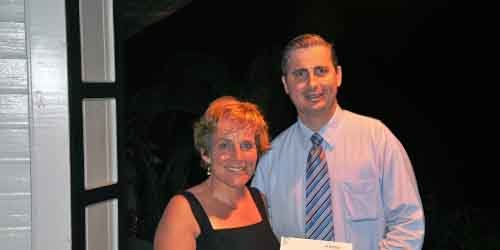
(Photo GIS, some time ago)
Since 2008, Jonathan Johnson has served as Island Governor of Saba. A former teacher, he has long been a familiar and trusted figure in the island’s public administration. As chair of both the Executive Council and the Island Council, guardian of public order and safety, representative of Saba in its relationship with the European Netherlands, and above all, as someone who knows the island inside and out, he has played a central role in Saba’s governance for many years.
I have come to know Jonathan as a leader who remains calm, even when circumstances make that difficult. He is not a man of grand gestures or administrative theater. He is a man of insight, perspective, and sound judgment. He knows when to press forward and when to exercise patience. He always has one objective in mind: serving the interests of Saba.
That may well be one of his greatest achievements. Jonathan mastered the art of navigating the relationship between Saba and The Netherlands. He understood that the relationship between a small Caribbean special municipality and the ministries in The Hague is not automatically an equal one. To achieve results for Saba, it is not enough to be right; one must also understand how decisions are made, who is involved, and when the moment is right to make a case.
Jonathan understood how The Hague worked, even as the people and structures within it changed over time. Just as importantly, he ensured that those around him understood it as well. He recognized the value of placing the right people in key positions: individuals who understood both Saba and the workings of the Dutch government. These were people who could bridge the realities of a small Caribbean island with those of ministries, policy papers, budgets, and political decision-making in The Hague.
Jonathan’s ability to build bridges showed in how he translated local needs into concrete administrative proposals. He could articulate the island’s priorities in a way that was administratively recognizable, politically persuasive, and practically achievable. The Saba Package is a particularly relevant example. It was more than a list of requests; it was a coherent presentation of the island’s challenges and ambitions, inviting the Netherlands to contribute in a targeted and constructive way. Jonathan understood that a successful proposal requires not only substance but also timing, form, and a compelling narrative.
His administrative strengths became especially visible during times of crisis. One striking example was Hurricane Irma in 2017. As one of the most powerful hurricanes ever recorded in the Caribbean, Irma brought profound uncertainty and exposed the vulnerability of island communities. Throughout that period, Jonathan did what effective leaders do: he prepared, communicated, remained visible, and provided reassurance. After the storm had passed, the value of that preparation became clear. There was damage, certainly, but there was also order, coordination, and a community that knew where it stood. Jonathan was never distant from the situation. He was present, approachable, and engaged. He knew the people, the places, the risks, and the practical challenges that emerge in the aftermath of such an event.
The same qualities were evident during the COVID-19 pandemic. As Saba’s first citizen, Jonathan provided the kind of leadership that national authorities later recognized. The Council for Public Administration specifically highlighted the “decisive and communicative” local leadership shown by figures including Jonathan Johnson, noting its contribution to the effective management of the pandemic in the Caribbean Netherlands.
Perhaps nowhere was Jonathan’s ability to represent Saba more visible than during visits by ministers, members of parliament, and members of the Royal House. He consistently conveyed the story of Saba with clarity and conviction. He knew what was working, where challenges remained, and what support was needed. He could translate concerns into concrete proposals and then turn those proposals into practical agreements.
Through all of this, Jonathan has meant a great deal to Saba. He has provided continuity and stability in government. He has strengthened cooperation with the European Netherlands. He has helped bring greater recognition to Saba’s unique position as a special municipality. And throughout the years, he has demonstrated that small scale need not be a weakness. On the contrary, much can be achieved when a community is well organized, when people know and trust one another, and when governance remains close to those it serves.
If I may mention one small disappointment from my current role as Chair of the Chapter for the Civil Orders, it is this: Jonathan has devoted less attention to Royal Decorations than we might have wished. I understand why. As a holder of public office, he may find it difficult to place such recognition in the spotlight. Perhaps it is also simply part of his character. Yet on an island like Saba, where volunteerism, community spirit, and quiet dedication are so important, visible appreciation matters. There are undoubtedly residents who have devoted themselves to society for many years and for whom a Royal Decoration would be deeply meaningful. It is a small observation in the context of a long and distinguished career, offered both with a smile and with sincerity.
Jonathan, you have fulfilled a demanding role for many years. On a small island, governance is never abstract. People know you. They speak with you. They look to you when circumstances become difficult. You have carried that responsibility with dignity. Not through grand words, but through your presence, by bringing together the right people, by articulating Saba’s interests with clarity and by achieving results step by step.
Thank you for your service to Saba. Thank you for your contribution to the Caribbean Netherlands. Thank you for your role within the Kingdom.
I wish you and your loved ones every happiness and success in the years ahead.
Ank Bijleveld
Ank Bijleveld was State Secretary for the Interior and Kingdom Relations from 2007 to 2010 and Minister of Defense from 2017 to 2021.
