
 Saba News News and Information from Saba Island, Dutch Caribbean
The Public Entity Saba (PES) is taking significant steps to transform waste management on the island through strategic investments in equipment that enable circular economy practices. These initiatives aim to reduce waste, protect the environment, and create valuable local materials for community use.
A New Approach to Waste Management
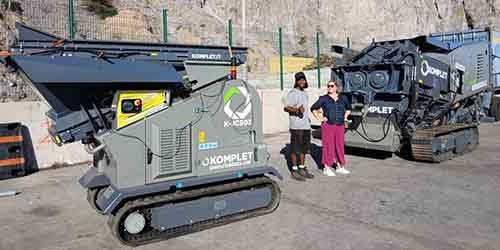
With support from an incidental subsidy provided by the Ministry of Infrastructure and Waste Management (IenW), PES has acquired specialized machinery designed to process waste materials into reusable resources. The investment includes equipment capable of shredding and crushing concrete waste while chipping green waste to produce base materials and landscaping products for use across the island.
This approach addresses multiple challenges simultaneously. By reusing valuable materials, the initiative reduces overall waste volumes, lowers material costs for local projects, and helps prevent erosion and environmental degradation previously caused by waste disposal at the Hell’s Gate Gut site. The machinery purchased includes two Komplet models: the Krokodile and the K-JC 503. The Krokodile, notably versatile, has proven its capabilities in demanding construction projects worldwide, including hurricane recovery operations on neighboring Caribbean islands.
First Major Project: Recycling the Old Gym
The new crushing equipment will see its inaugural deployment in January, tackling a substantial challenge: recycling over 500 cubic meters of concrete from the demolished gym. This material is currently stored temporarily at Tent Bay, where PES has implemented measures to prevent any environmental impact during the storage period. Once processing is complete, the Tent Bay site will undergo thorough cleaning and restoration, and the crushed concrete will become available for future construction projects across the island.
Building Local Capacity Through Training
Recognizing that equipment is only as valuable as the people who operate it, PES is hosting a comprehensive training session on January 12-13. Manufacturers will provide hands-on instruction not only to PES waste management staff but also to contractors and interested community members who register for the sessions.
This knowledge-sharing initiative serves multiple purposes. By developing local expertise in equipment operation and maintenance, PES ensures that contractors can support future projects requiring these machines. Additionally, participants in the training will have the opportunity to obtain crushed concrete from the gym project for their own purposes, though recipients will need to arrange transportation independently.
Interested in participating? Register for the training session at https://bit.ly/48OV22O
Integrating Sustainability Into New Construction
The concrete recycling from the gym project represents one component of a comprehensive sustainability strategy for Saba’s new educational facilities. The project, which includes the construction of a new gym and technical school in St. Johns, has received Duurzaam Maatschappelijk Vastgoed (DUMAVA) subsidy support from the Ministry of Interior and Kingdom Relations.
These new buildings incorporate sustainable design principles from the ground up, featuring natural ventilation systems, strategic sun protection, green roofs, and terraces—all selected to minimize heat absorption and reduce environmental impact while keeping long-term maintenance requirements low.
Building Resilience for Small Islands
These initiatives contribute to a larger vision: developing Saba’s local capacity while fostering regional cooperation in creating smart, sustainable waste management strategies specifically adapted to small island environments. Such contexts present unique challenges, with limited resources and infrastructure demanding innovative solutions.
Circular economy models show particular promise in these settings, offering practical ways to repurpose waste materials for essential sectors like construction. By transforming what was once discarded into valuable resources, Saba is reducing its environmental footprint while building resilience and self-sufficiency for the future.
PES
