
 Saba News News and Information from Saba Island, Dutch Caribbean
No strategic reserves of (drinking) water, food, medicines, or fuel have been established for the inhabitants of Bonaire, St. Eustatius and Saba. Despite the vulnerability of the Caribbean Netherlands to natural threats, such as hurricanes or volcanic eruptions, and the tense situation in Venezuela, located less than 70 kilometres from Bonaire, the Dutch Cabinet has not set targets for a strategic reserve. In the event of a crisis, for example, the supply of drinking water on the so-called BES islands would be exhausted within a few days.
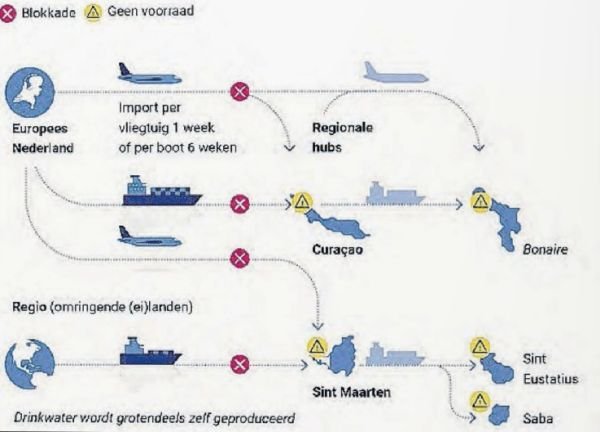
A strategic reserve is an extra stock of (essential) raw materials that is kept in reserve. This stock is not available for normal use and is only utilised when the supply is interrupted by, for example, a crisis.
The Dutch Audit Chamber previously conducted an investigation into strategic reserves in 2022. At that time, they looked at the European part of the kingdom.
Under European Union (EU) regulations, the Netherlands has obligations to maintain certain strategic reserves. However, these do not apply to the Caribbean Netherlands.
Because the chamber determined that no strategic reserves was established, the presence of regular stocks of (drinking) water, food, medicines and fuel on the islands has been mapped out. Regarding medicine and fuel, the islands possess a relatively large regular stock.
Saba and St. Eustatius have a regular stock of medicines sufficient for one to two months. For Bonaire this is three to six weeks.
Regarding regular stocks of food and (drinking) water, the picture is very different. St. Eustatius has a reserve of drinking water sufficient for seven days and Bonaire for only three to four days.
On Saba, a water shortage already arises if the supply is interrupted for longer than a day.
The regular stocks in the Caribbean Netherlands are dependent on imports by commercial companies and are structurally vulnerable to disruptions in the international logistics chain. The consequence of this is that in a crisis, private parties and commercial considerations determine what happens to the regular stocks of (drinking) water, fuel, medicines, and food.
Virtually all goods for Bonaire, St. Eustatius and Saba are supplied via the two “hubs” Curacao and St. Maarten. In a crisis situation, this quickly creates the additional risk that the islands will start competing with each other for supplies.
No targets have been set by government for strategic reserves in the Caribbean Netherlands. As a result, there are no clear agreements between the central government, private parties, vital sectors and public bodies about who is responsible for what.
Where formal agreements regarding responsibilities do exist, such as for fuel, there is uncertainty regarding the division of roles in practice. If an island does not possess sufficient strategic reserves, this can have major societal consequences because shortages quickly arise that can directly affect daily life.
The Jetten Cabinet must therefore determine what level of strategic reserves is desirable in the Caribbean Netherlands, record this and indicate who is responsible for what.
This study is a pre-publication of the 2025 Accountability Audit by the Netherlands Audit Chamber, which will be published on this coming May 20 with “Safety of the Netherlands” as theme.
The Daily Herald.
