
 Saba News News and Information from Saba Island, Dutch Caribbean
The Executive Council of Public Entity Saba was in Amsterdam to support the Saba Lace Ladies, who carried one of the island’s oldest traditions to an international audience at craft festival “Ambacht in Beeld” this past weekend.
The festival was held on Saturday, September 26, and Sunday, September 27, at the NDSM Loods in Amsterdam-Noord. For its twelfth edition, the festival again turned the hall into a large working craft space, with more than one hundred workshops, masterclasses and demonstrations.
This year’s festival had a special focus on the Caribbean. Organisers invited craftspeople from the Caribbean Netherlands islands Saba, St. Eustatius and Bonaire, from Aruba, Curacao and St. Maarten, and from Suriname to share their skills with the public. The organisers said that many of these crafts rely on local materials and knowledge handed down through generations, and that featuring them helps make this intangible heritage more visible and better preserved.
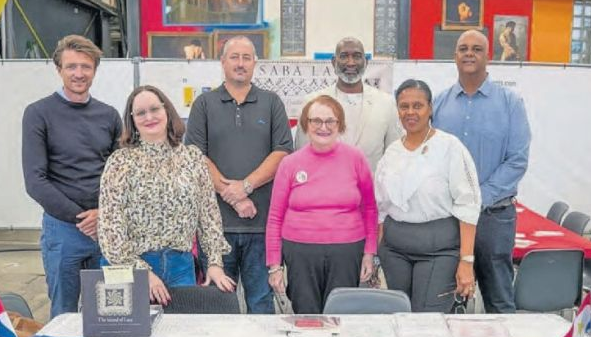
Saba was represented by Saba Lace Ladies Alma Peggy Barnes, Miranda Simmons and Madelyn Johnson. Barnes and Simmons demonstrated the craft and met visitors who wanted to learn about the tradition, while Johnson sold Saba Lace books and items at the stand and photographed the delegation’s activities. Festival-goers could also try the craft themselves. Barnes and Simmons led two-hour, beginner-friendly Saba Lace workshops on both days of the festival, in which they taught participants how to prepare the linen, make a traditional hemstitch border and create a classic web border, and explained the his
tory and precision behind the craft. No previous sewing or embroidery experience was required. Participants were provided with linen, Saba Lace thread, a needle and a pattern guide, and each took home a small handmade Saba Lace sample along with the remaining materials.
Barnes has practised the craft since childhood, learning from her mother and other master lace makers, and has spent decades creating, demonstrating and teaching Saba Lace at workshops, community events and cultural exhibitions. Simmons, known on the island as Teacher Miranda, is a lifelong educator, culture teacher at Sacred Heart School and museum curator, and has played an important role in sharing Saba’s traditions with younger generations.
“A real pleasure”
In a video released by Public Entity Saba, the three women spoke about what the experience meant to them.
“It has been a real pleasure to be here at the Ambacht in Beeld Festival and to represent Saba and our Saba Lace-making tradition. Seeing people so curious about Saba Lace and willing to try it themselves has been very rewarding,” said Johnson. “Saba Lace is something that connects us to our history and to the women who have carried this tradition forward. Being able to share that story here in Amsterdam is something I’m very proud of.”
Simmons described the trip as “a wonderful experience”, given the chance to share Saba Lace with people from many different backgrounds. “It’s special to see people taking an interest in the craft and wanting to learn more about where it comes from,” she said. “For me, sharing Saba Lace is about more than demonstrating a skill. It’s about sharing a part of Saba’s history, culture and identity, and helping to keep this beautiful tradition alive for generations to come.”
Barnes said being in Amsterdam meant a lot to her personally. “This is a tradition that has been passed down for many generations, and I’m happy to have the opportunity to show the people how special it is and where it comes from,” she said. “To see people interested in learning about the craft and trying it themselves is wonderful. I hope that by sharing Saba Lace here, we can help keep this important part of Saba’s heritage alive for generations to come.”
“A proud moment”
Commissioner of Culture Eviton Heyliger visited the festival as part of a working visit to the Netherlands, during which he has been attending meetings and official engagements on behalf of the island.
“It’s especially meaningful to see Saba and our cultural heritage being represented here, and to see Saba Lace being shared off-island,” Heyliger said. “Opportunities like this provide much-needed exposure for our culture and allow others to learn about our traditions, our skills and our stories all things that make Saba unique.”
The Commissioner praised the three lace makers for embracing the opportunity. “They are not only representing themselves, but also carrying a piece of Saba and its cultural heritage with them,” he said. “Seeing people from different backgrounds take an interest in Saba Lace, ask questions and try the craft for themselves has been truly special. Moments like these show the value of opening our traditions to others and creating new connections through our culture.”
Heyliger also thanked the Community Development and Culture Department, the Saba Tourist Bureau, the Sea & Learn Foundation and the Saba Heritage Center for their support in preserving, promoting and sharing.
The trip began with an invitation. Earlier this year, Wendy van Wilgenburg of Stichting Ambacht in Beeld invited the Saba Heritage Center to send craftspeople from Saba to the festival. With backing from the Saba Tourist Bureau, the Department of Community Development and Culture, and the Sea & Learn Foundation, Saba was able to send three representatives instead of one.
“Seeing Saba represented here in Amsterdam is a proud moment,” Heyliger said. “Our island may be small, but the traditions and knowledge we carry have a place far beyond our shores.”
A craft with deep roots
Saba Lace, also known as drawn-thread work or “Spanish Work”, has been part of island life for about 150 years. The craft came to Saba in the 1870s through Mary Gertrude Hassell Johnson, whose parents sent her to study at a convent in Caracas, Venezuela, where the nuns taught her the needlework. When she returned home, she passed her knowledge on to a few women, and a cottage industry was born. At first the women made the pieces and the men sold them on trips to nearby islands.
The work demands great patience. The lace maker starts with solid linen, cuts out a number of parallel threads and ties them off, then works thread back into the open space to form a range of patterns.
The turning point came in 1884, when regular mail service first linked Saba to the outside world. The wives and daughters of the island’s seafaring men turned the craft into a mail-order business. They copied the addresses of American companies from packages arriving on the island, then wrote to those companies describing their needlework and offering it for sale.
The trade became a vital source of income for the island. In 1915, some 250 of Saba’s 2,500 residents earned a living from drawn-thread work. By 1928, the women were exporting about US $15,000 worth of lace a year. Lacework remained one of the main sources of revenue for the island’s economy until the 1950s. The craft has been the subject of two books and won the Prince Bernhard Caribbean Culture Prize.
Today the tradition is carried on by a dedicated group of women. The Saba Lace Ladies regularly meet at the Saba Lace Room at Lam-bee’s Place in Windwardside, where visitors can watch the pieces being made.
Public Entity Saba thanked Barnes, Simmons and Johnson for carrying a piece of Saba with them and sharing the tradition with audiences in the Netherlands.
The Daily Herald.
